Unlike musical notes, linguistic pitch specifications cannot be invariantly associated with context-independent f0 values, but rather are massively, multi-dimensionally relative. Barnes et al. (2020, p. 133)
“One basic observation about this variation is that it tends to affect higher f0 targets more saliently than lower. Rather than shifting globally upward or downward, pitch range seems instead to be compressed or expanded, primarily through raising or lowering of its topline or ceiling.” (Barnes et al. 2020, p. 133)
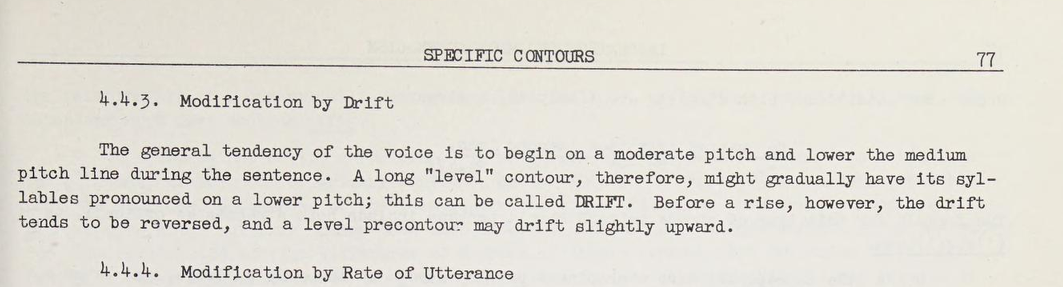
“Perhaps the most exhaustively studied pattern of contextual pitch range variability is downtrend, a term spanning a range of common, if not universal, phenomena involving a tendency for pitch levels to fall over the course of an utterance, which has long been recognized (e.g. Pike 1945: 77)”. (Barnes et al. 2020, p. 135)
“Our usage here is as follows:
‘declination’ refers to ‘a gradual tapering off of pitch as the utterance progresses’ (Cohen and ’t Hart 1965). Declination is putatively global, gradient, and time dependent.
‘Downstep’ refers to a variety of categorical (or at least abrupt) lowering patterns, usually, though not exclusively, affecting High tones.”
“Lastly, the term ‘final lowering’ (Liberman and Pierrehumbert 1984) refers to various (p. 136) probably distinct phenomena involving low ered pitch in domain-final contexts.” (Barnes et al. 2020, p. 135)
Yuan and Liberman (2014) (earlier version: 4-page interspeech paper, Yuan and Liberman (2010))
How do you adjudicate between the hypotheses about whether declination is under linguistic control or purely biomechanical (i.e., "breath group"?
Language specificity in declination patterns (Yuan and Liberman (2014)'s English vs. Chinese broadcast speech comparison)
Downstep is most commonly described as the lowering influence of a low tone (L) on a following high tone (H), such that a new, lower, "ceiling" is set for all subsequent Hs within a specifiable domain or prosodic unit (Connell 2011, p. 824)
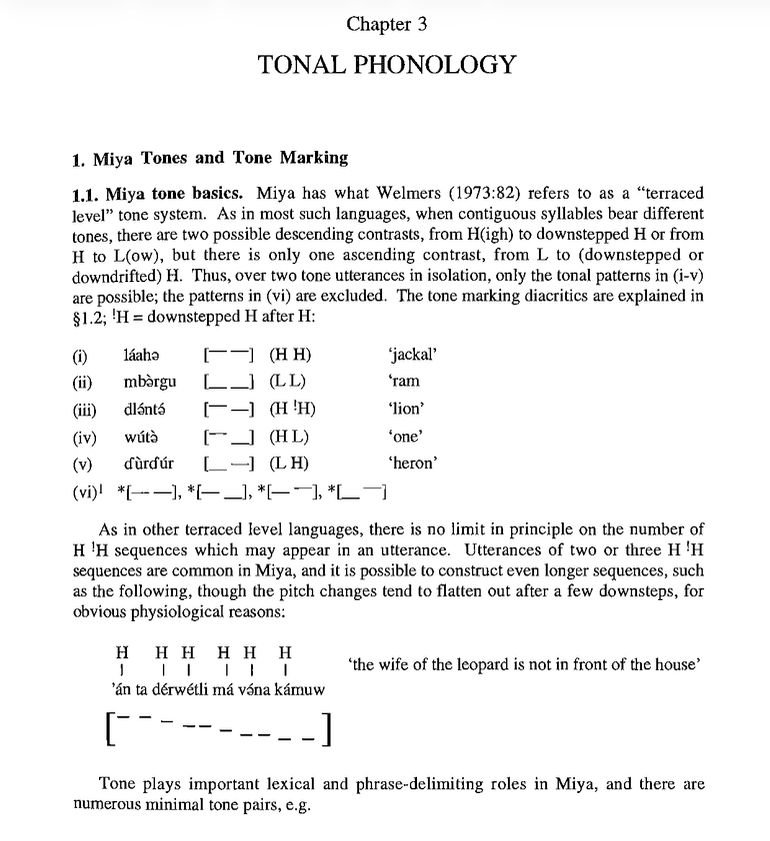
Examples of terracing and downstep: Miya demo (LING 506)
Excerpt from Schuh (1998) Miya grammar:
'Automatic' vs. 'non-automatic' downstep (Stewart 1965):
However, the !H* (‘downstepped H star’) pitch accent label is dependent on the immediately preceding labels. It indicates that there is a specific tonal relationship between the prominence labelled !H* and the preceding pitch accent. Specifically, a downstepped H pitch accent indicates that the tone of the prominent syllable is realized by a perceptually lower f0 than that of an immediately preceding High tone: the tone has ‘stepped down’ from the preceding High.
Also, different researchers may vary in whether they choose to mark downstep, e.g., !H, or not in the f0 scaling of an annotated recorded passage/sentence
More generally "TobI-style" transcription has been criticized for inadequacy in describing tonal scaling, see for instance Dilley and Breen (2022) commentary in Prosodic Theory and Practice book and their proposal for RaP, another transcription system, and other work by Dilley and colleagues